Web offset printing: When thousands of prints need to look the same

Bring your brand to life
Explore over 1,000 customisable products designed to showcase your brand and leave a good impression.
What actually changes
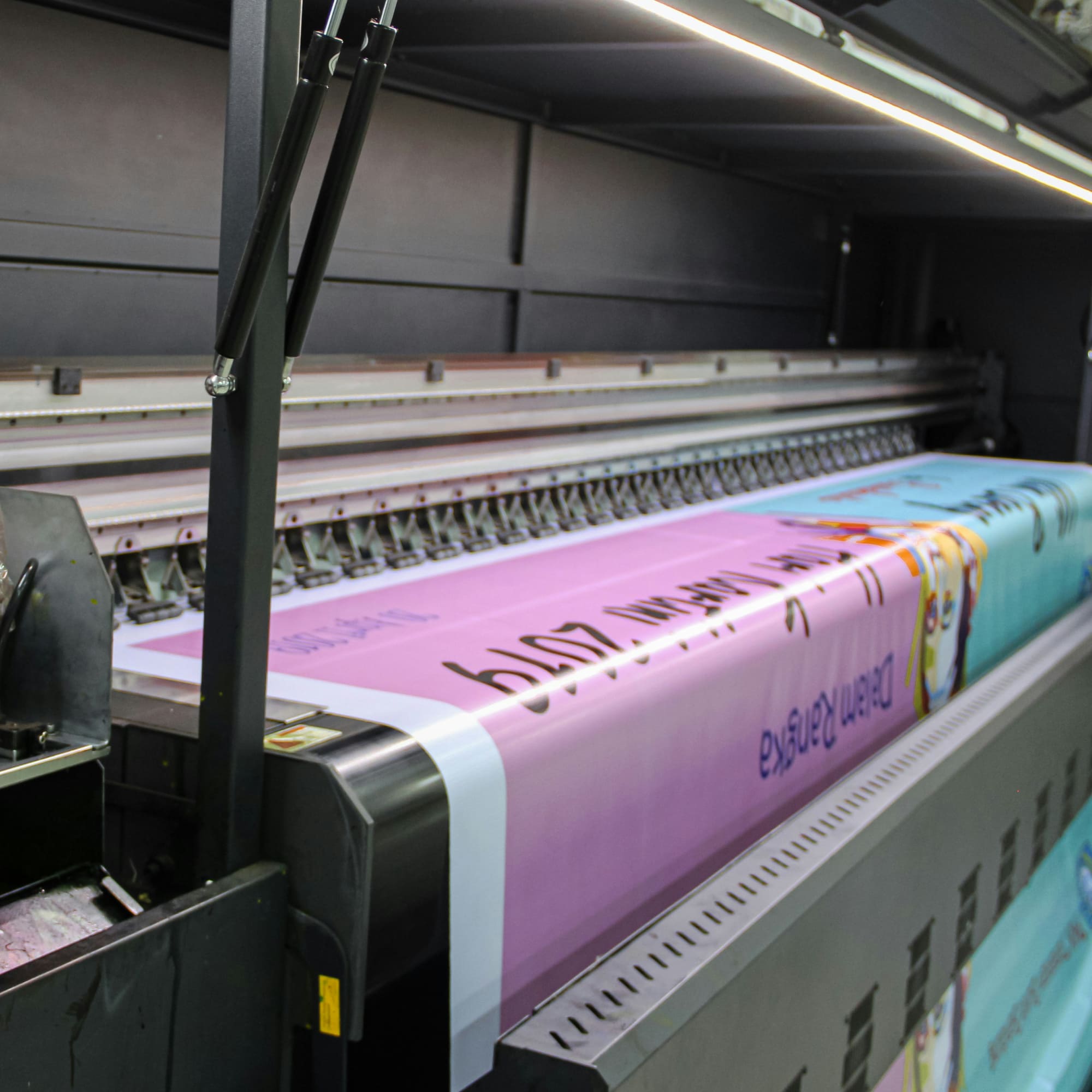
Most people assume the difference between web offset and other commercial printing is the machine. It isn't. The difference is the paper: a continuous roll runs through the press instead of individual sheets, fast enough that thousands of identical pieces come off the end in the time a short run elsewhere would spend on setup. That's the shift. Plates, ink, colour stations: all work the way they do on a sheet fed press.
For us, web offset only comes into a project on the paper side. Catalogues, product guides, packaging inserts: the printed collateral that travels with the merchandise, not the merchandise itself.
Roll instead of sheets
The underlying process is standard offset lithography: the design transfers from a plate onto a rubber blanket, which prints onto the paper. What changes is the substrate format. A continuous web moves through the press at high speed, printing both sides at once in most setups. Colour builds up in CMYK layers, one per station, and registration, the alignment between those layers, holds automatically through the run.
Get the registration wrong and the colours drift apart across the run, not just on one sheet. That's the failure the automation exists to prevent, and it's why the makeready period before a run starts takes as long as it does.
Drying, cutting, finishing in one pass
After printing, the web runs through a drying unit. Heat set printing evaporates the ink solvents with hot air. Cold set printing lets uncoated paper absorb the ink directly, no heat involved. Either way, the web is then cut, folded, and finished inline with the press. What comes off the end is a finished product, not a stack of sheets waiting on a second machine.
Paper, not products
Web offset covers high volume paper based work: magazines, newspapers, catalogues, direct mail, brochures, books. In a merchandise operation that means the collateral around a project, the guide that explains the range, the insert in the box, not the range itself. It doesn't print on garments. It doesn't print on hard goods. If what's needed is a logo on a jacket or an engraving on a bottle, this isn't the process, and we'd say so rather than force it.
Where the cost drops, and where it doesn't
Speed and volume are the advantages. The continuous feed and inline finishing mean large quantities come off the press in a fraction of the time a sheet fed run would take, and cost per unit falls as volume rises. Once a press is calibrated, colour holds steady across a long run, and it takes a wide range of paper weights without complaint.
None of that helps a client who needs a few hundred catalogues by next week. The setup, a plate for every colour, a real makeready period before a single good sheet comes off, only earns its cost back at volumes where that cost gets spread thin. Below that threshold, digital printing is the honest answer. Not a smaller run of the same process.
When we'd use it, and when we wouldn't
Web offset earns its place when the job is large volume paper based material and the design holds steady between runs. New artwork means new plates, so it's not the format for anything personalised or updated mid run. Short runs, variable data, one off packaging: digital does that job better.
Roll instead of sheets. Drying and finishing in one pass. Paper and board only. Volume as the only lever that moves the price. That's where web offset sits in a merchandise operation. And the question underneath it: is this a run large enough to make the setup pay for itself, or a job that digital would do better.
About the author

Sun Ray Sunglasses

Trawler Beanie

Nike One Dri-FIT Elastika Tank Women